Art Focus on Concept Not Too Much on Detail
What Are The Fundamentals Of Art? (And How To Learn Them)
TipsFundamentals Disclosure: This post may comprise affiliate links. That means if you buy something we get a small commission at no extra price to you(acquire more than)
Anyone that takes their art education seriously will know the importance of the fundamentals. These fundamental topics are like the foundation of a building: you need the foundation earlier you tin can get more detailed.
Whether y'all want to piece of work equally a visual development artist, concept artist, animator, illustrator, or anything else in 2D/3D art, fundamentals are a necessity. But how exercise you get started?
In a recent mail service I explained the importance of fundamentals and in this postal service I'd similar to focus on a few of these topics with helpful learning resource. The best mode to get better is to practice. But you demand focused do to encounter the best results.
If you want some advice from a primary skip to 35:40 in this FZD podcast. Feng Zhu is a veteran concept artist who runs his own entertainment art school in Singapore. He only teaches the fundamentals and he explains why these are so damn of import for every creative person to learn.
Grade
The idea of form is very general simply also very important. Artists who larn to recognize form see beyond the 2D paper(or screen). They're able to create objects that look realistic because the forms look jubilant and lively.
Forms ascertain anything with book. The human body has a lot of different shapes and forms, particularly in the face. Your ability to see and understand forms will be crucial to your success as an artist. This is a fundamental skill for adept reason.
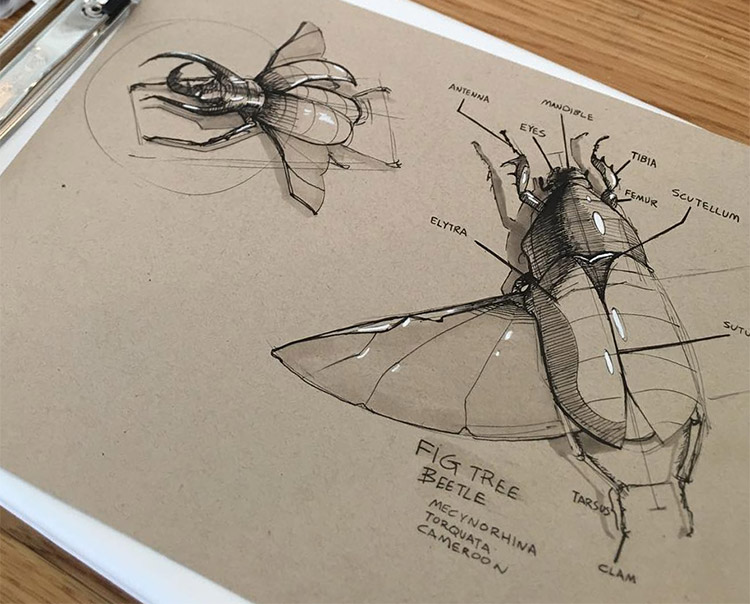
And then how practice you lot practice this fundamental skill? I find it's best to get-go with shapes.
Everything in life can be broken downward into smaller forms like spheres, cones, cylinders, and boxes. If you tin can describe these basic shapes in every perspective then yous can reconstruct anything.
If yous want to better define your forms then follow through with cross-contour lines. This guide volition get you started and show yous some great examples.
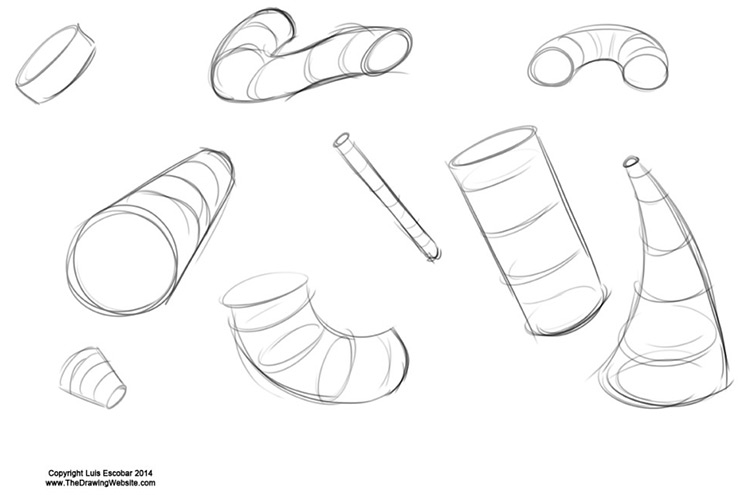
This can be one of the easiest skills to practice but one of the toughest to master. You'll need to put in the work and really endeavour to run into, not just copy.
When you lot start drawing from life you might try the Drawabox lessons just to practice forms consistently.
Perspective
Another must-have skillset is the ability to draw or pigment in perspective. You tin find lots of groovy articles talking about what perspective is and how information technology works. Only there's only and so much free content out there to aid y'all learn.
However I will acknowledge in that location are dozens of costless perspective tutorials on YouTube if you search difficult enough. This is probably the best place to start.
Seeing in perspective is knowing that as things move abroad from the viewer'south middle, things seem to go smaller. Terms like horizon line and vanishing point are basics and must exist understood to larn perspective.
Perspective is something you but get improve at with practice. It also connects into everything you create.
For example, the last section recommended exercises for cartoon boxes and cylinders. To draw them correctly they'll need to be in perspective, whether y'all understand the rules perspective or not.
Just proceed drawing stuff and branching into new avenues. As you become curious about perspective look up some tutorials and follow forth. Some videos may recommend using a ruler while others strength you to train your eye.
The concepts really aren't hard to main but they exercise take time.
And the best thing virtually perspective is that you don't demand to worry about tone, value, colors, or light/shading. These are necessary skills if you lot're working for a finished cartoon. But a simple perspective exercise can be done in one single tone.
If you want a jumpstart in your perspective work at that place are ii books y'all should try. The first is Perspective Made Easy, very inexpensive and a classic for new artists.
More intermediate artists(or confident beginners) should also report from Scott Robertson'southward How To Draw. The book offers real applied communication with exercises and case studies that will assist you meliorate drastically.
There are tons of perspective books you tin try so it's good to have a plan of how & what to report.
But to requite you a diverseness of choices here are another perspective books yous might like.
- Basic Perspective Drawing: A Visual Arroyo
- Perspective Made Piece of cake: A Footstep-by-Step Guide
- Perspective for Artists
Anatomy
Some may argue that beefcake is not a fundamental topic because it'south not required for a good cartoon. Merely information technology is a key for professional work, specially in entertainment art considering it applies to whatsoever living brute that you try to draw.
In one case yous understand how joints work you'll exist able to see how bones and muscles move. This applies not but to humans, but to any creature or creature with a skeleton.
But anatomy is one of those topics yous tin can study for years and notwithstanding not master. It's a key concept just very difficult to internalize. But you lot have to start somewhere, so just offset ho-hum and endeavour to focus on one area at a fourth dimension.
If you're just getting started with beefcake there are ii resource I'd recommend.
The first is Goldfinger's Human Anatomy for Artists. This is very dry and not meant to exist a one-off learning resource. But it volition prove invaluable as a reference guide because it'south so exhaustive and reliable.
Make new artists studying anatomy will do great with Proko'south anatomy video course. It's cleaved into 3 unlike courses and then you can choose to pick upwards the areas you really need to study.
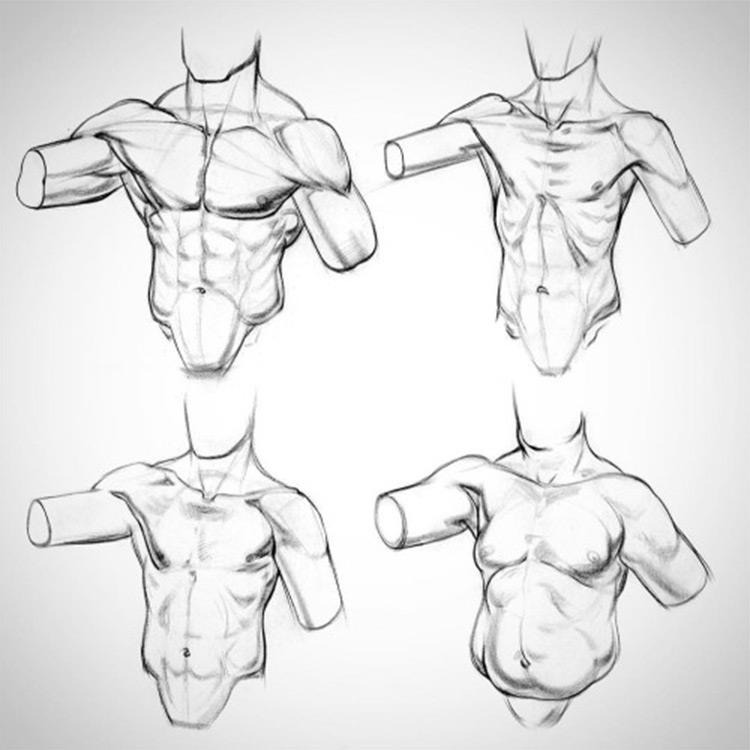
This is what I utilise to report beefcake and I would never have wanted to start anywhere else. Stan is an astonishing teacher, both with his demonstrations and his choice of words when explaining things.
I've yet to find a ameliorate anatomy series and while at that place are many options out there, Proko's is cheap and great for beginners.
Anatomy is hard. Not only because of the technical component, only because of the sheer volume of information. Don't let this overwhelm you.
Study anatomy in bits and exercise lots of studies. Get out to figure drawing sessions whenever possible. There's no replacement for working from a alive model.
Anatomy studies will too assistance you understand proportions and relationships betwixt elements. This Tuts+ guide is a prissy identify to become started reading about this stuff.
Composition
Composition is harder to teach from scratch considering it'due south more most the finished artwork. When all the pieces come up together and class a whole you get a composition.
The overall layout of a slice is very important. Artists often consider things similar the dominion of thirds or the infamous gilt ratio. Neither truly defines a composition, only they can both go into your decision making.
Your choice of limerick is defined by size, angle, perspective, and attention on foreground/background objects. Equally you lot can tell this key skill really gets developed later in your artistic progression.
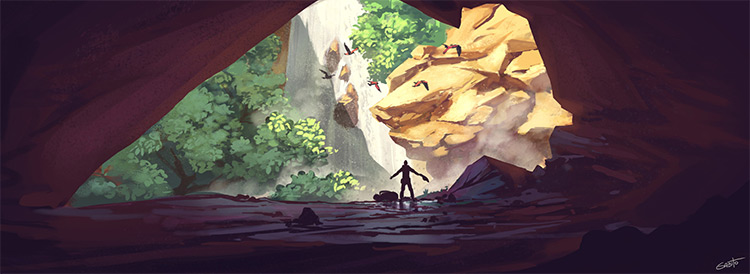
Merely information technology'southward still something you want to consider while practicing. Information technology becomes much more important when you move onto digital painting because every painting sets a scene. Yous can find lots of composition tips but information technology's tough to actually teach fundamentals of composition without bodily exercise.
My suggestion is to study the work of other artists. Y'all'll stumble onto paintings that just stand out to you for whatever reason. Salvage these and continue them in a folder for inspiration. Check back every so often and try drawing your own ideas with a similar composition.
I'd also recommend learning a chip about limerick every bit information technology relates to photography. A lot goes into crafting beautiful photos and professional photographers follow similar compositional guidelines.
The best written report cloth is a book called Mastering Composition past Ian Roberts. Information technology'southward a few years old but the cloth is priceless and genuinely useful to all forms of art. Plus it comes in CD/audiobook format if you'd prefer that route.
If you lot do and continue pushing your compositions I guarantee everything will start to click. This is a fundamental skill that takes a while to build upwards and empathise. But one time y'all get it you won't be able to lose information technology.
Two other books I'd recommend for artists studying composition are called Pictorial Composition by Henry Rankin Poore and one only titled Composition by Arthur Wesley Dow.
Value & Lighting
The subject of value is immensely detailed because information technology covers everything related to rendering. Your noesis of class volition bear witness immeasurably helpful when studying value.
If y'all're brand new to value and so just keep cartoon and trying to return as best y'all tin. You'll notice free videos on YouTube that teach rendering, simply none will give you lot everything you need.
I recommend doing lots of value studies especially when you're just starting to learn fine art. They tin can be stressful but they tin can likewise exist very educational.
Start out with withal life drawings and progress into portraits. Stan Prokopenko has a slap-up portrait drawing course which can help you lot practice the fundamentals of drawing realistic faces and nailing the values.
Simply drawing objects effectually the house can yield fruitful results as well. Inanimate objects don't motion then y'all get the chance to written report from life and expand your efforts across days or weeks at a fourth dimension.
Studying value is very much the study of light and shadow. But there is a technical side of light that y'all'll want to pay attention to if you're going for technical rendering.
Lighting implies shading and vice-versa. You lot can't have 1 without the other.
One time you get into painting you'll exist more concerned with colors in your lights & darks. Merely y'all should always be able to convey the same bulletin through drawing with basic materials.
Shadows are cast in the absence of light, so there's ever a part of the object receiving more low-cal than other parts. This makes sense in theory only it's a whole different ball game when you lot put it into do.
Check out this Tuts+ article if you want to acquire more well-nigh lighting & shadows. Your values tin exist the same whether you lot're using color or grayscale. This is the dazzler of studying value because it actually helps you improve your color selection after on.
Take a look at the color keys and limerick pained past Singaporean artist AC Masoen.
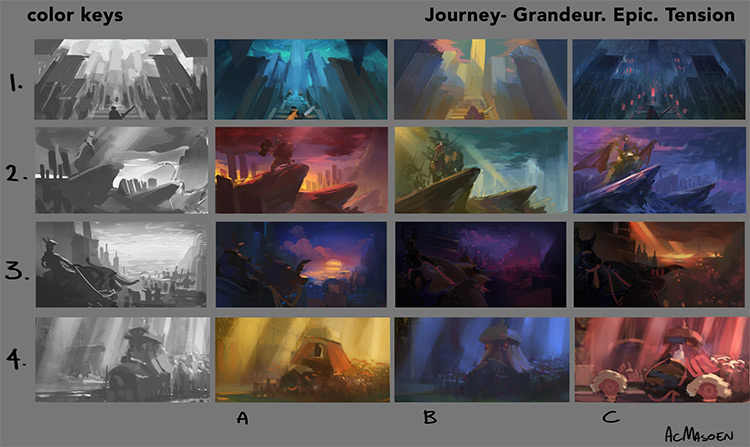
His understanding of light is expressed brilliantly in these keys. Rendering is not very tight, just expression is high enough quality to go the message across. This is how powerful the fundamentals of value and light can exist.
For learning recommendations I cannot overstate the importance of How To Render. Scott Robertson is a skilled artist and this book should exist regarded as the best guide for beginners to jump into value.
It is a large book and it covers a lot. Probably more than a typical beginner needs to know. Only this is why information technology's so dandy considering How To Return will keep teaching y'all for years later you buy it.
For a more technical guide I recommend Light for Visual Artists by Richard Yot. Easily one of the highest-rated books on this discipline for expert reason.
Moving on from value is the somewhat-related but very unlike subject of color theory.
It's way too big to break into hither. But if yous're set up to move into colour then exist sure yous have Colour and Low-cal by James Gurney. Undoubtedly the best volume you could go for understanding how light affects colors in a painting.
The terminal book I want to recommend wraps up all these fundamentals into one big compilation. It'southward called Fine art Fundamentals and was written past 3 concept artists working professionally in the industry.
It covers all the major fundamentals like perspective, light, anatomy, and limerick.
It's non as in-depth equally my other recommendations, only information technology is i of the few books focused solely on the fundamentals. Also it was written by professional person concept artists so their educational activity methods align perfectly with aspiring artists looking to piece of work in the industry.
At the cease of the twenty-four hour period information technology doesn't really affair how you report or which books/courses you lot use. All that matters is the full hours yous spend practicing. And then pick whatever interests you the about and just go going!
If you can do for vi-12 months only on central skills you will run across noticeable improvements.
Fundamentals are crucial to every entertainment art career and they truly pave the way to your future success as an creative person.
Source: https://conceptartempire.com/what-are-the-fundamentals/

Post a Comment for "Art Focus on Concept Not Too Much on Detail"